The Invisible Wanderer: Hunting the Ghost Black Holes of the Milky Way
For years, stellar theory predicted the Milky Way should be teeming with millions of hidden black holes—rogue remnants of dead stars, wandering solo through the void. But how do you find something that is perfectly invisible? You wait for it to warp the universe.
Astronomers have achieved a major scientific first: the clear detection and confirmation of an isolated, stellar-mass black hole drifting freely through our galaxy. This cosmic ghost is about seven times the mass of our Sun, and its very existence confirms a massive, unseen population of objects that were previously only theoretical.
This incredible object was not spotted by light, but by its sheer gravity. The black hole, named MOA-2011-BLG-0462 (or MOA-11-191), was detected via a rare phenomenon called microlensing.
Imagine a distant star shining steadily. When a massive, dark object—like this black hole—passes directly between us and that star, its gravity acts like a magnifying glass, briefly brightening and shifting the star’s light. The length and strength of this warp allowed scientists to calculate the object’s mass and confirm it was too heavy to be a mere neutron star.
The object’s high speed and lack of a companion star suggest it was likely “kicked” out of its birth system by an asymmetric supernova explosion, sending it careening through space as a solitary rogue.
Millions of Ghosts: What This Means for Our Galaxy
This single confirmed sighting throws open a window to the true scale of the hidden universe. Scientists estimate there may be up to 100 million of these silent wanderers across the Milky Way. They are our invisible neighbors, and now we know for sure they are out there.
The work that led to this amazing discovery was published and discussed in articles like the one posted here: Discovering the Solitary Black Hole.
Art Inspired by the Unseen
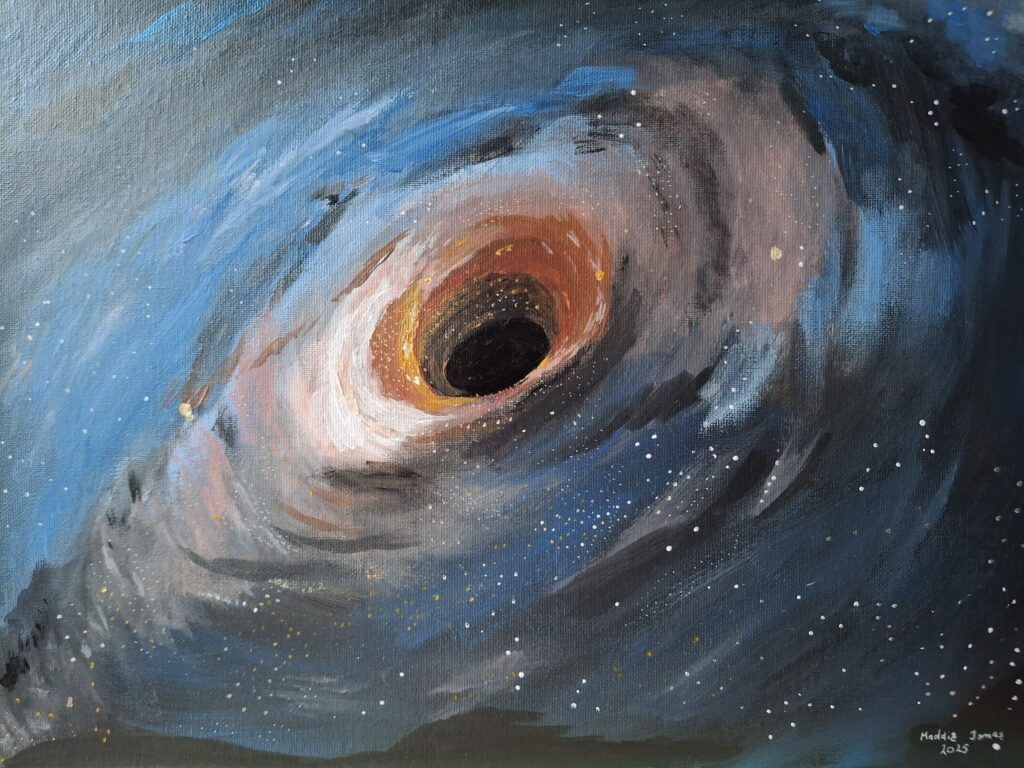
This discovery immediately inspired me to translate the science into art. My new painting, “Maelstrom’s Eye,” is a visual meditation on the invisible forces at play.
The painting (see attached image) is a direct response to the idea of a solitary, profound void moving silently through the star fields. While the real object is dark, the artwork visualizes the energetic, high-contrast field of gravity it creates—the storm of stars and light it inevitably warps and consumes. It’s a tribute to the elegant physics that allows us to find the unseeable.
This YouTube video explains the concept of gravitational microlensing, which was key to this black hole discovery: Microlensing Explained.